


“Behold I make all things new.”
As part of the Golden Jubilee celebration of the Diocese of Arlington, the Cathedral of Saint Thomas More is being renovated. Prior to the renovation, Bishop Burbidge sought the counsel and input of many different groups in the diocese, including the Presbyteral Council, the Diocesan Pastoral Council, the Finance and Building Commission, the Cathedral Pastoral and Finance Councils, and the Diocesan Finance Council. Each group provided sound advice and support for this project.
Bishop Michael F. Burbidge on the Cathedral renovation
“As a bishop, I have the privilege of traveling to many other dioceses, particularly in our region, and witnessing the beauty and majesty of their cathedrals. It has been clear to me for some time that, for the benefit of the faithful, a cathedral renovation would more accurately reflect our devotion, love of God and evangelistic spirit. I pray that the coming changes to St. Thomas More Cathedral will be a blessing to our entire community, where all feel welcome to join as brothers and sisters in faith, to worship God and receive the gifts of the Holy Spirit.”
Explore this page to learn more about the renovation of the Cathedral of St. Thomas More in Arlington.
Read the full article in the Arlington Catholic Herald.
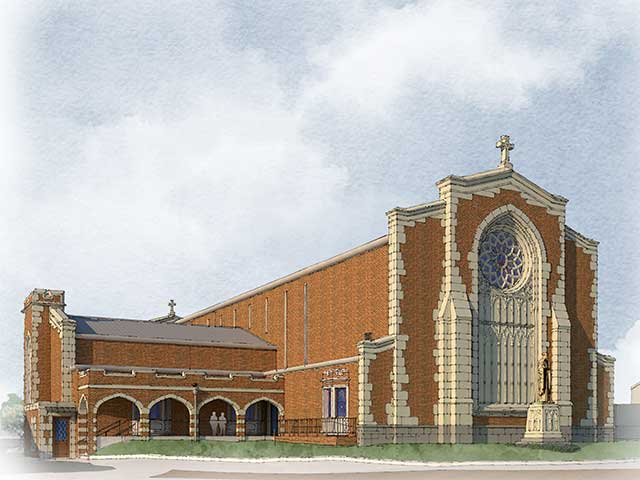
Northeast view
The word cathedral comes from the Latin “cathedra,” which is the bishop’s chair and signifies his governance and pastoral ministry over the local church. The cathedral serves as a principle of unity for the entire diocese. In addition to being a parish church, it should also be considered home by the faithful from throughout the diocese.
“The cathedral is the mother church of the diocese, the church from which all others take their cue. As the bishop's church, it is the place to which all should be able to look to encounter the truth and the beauty of the Gospel,” - Father Paul D. Scalia, diocesan episcopal vicar for clergy.
Image: A northeast view of the cathedral shows the transept, rose window and a statue of St. Thomas More.
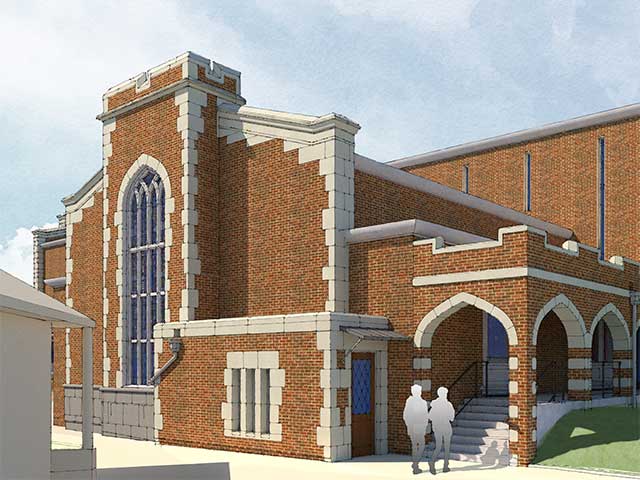
Transept view
Truth and beauty complement each other. The beauty of a cathedral should speak to the beauty of the Catholic faith, not only to the faithful but also to all who pass by. Its beauty should prompt a sense of awe and draw people to the truths it signifies. Thus, the cathedral becomes a means of evangelization.
Image: The rectory side of the Cathedral of St. Thomas More will be transformed. The artist’s rendering of the archways and decorative stonework illustrates how renovations will invite people to come in.
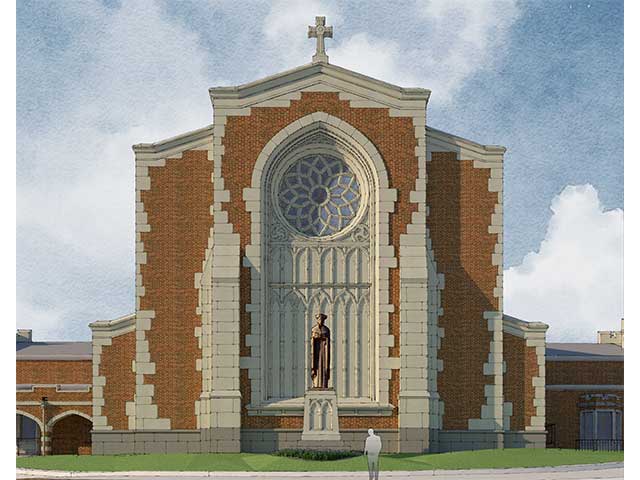
Rose window
The north façade of the cathedral facing Glebe Road will be rebuilt and will include a rose window depicting the theme of “The New Jerusalem” as found in Revelation 21. In the center, rendered in stained glass, will be the image of Our Lord. Surrounding this central image will be stained-glass depictions of 12 gates with 12 angels. The next ring of stained glass will depict 12 walls with the 12 apostles. Twelve precious stones will be represented in the outer ring.
It is the hope that all those who travel along Glebe Road throughout the day will be drawn to the beauty of the rose window and will be inspired to seek its deeper meaning in their lives — the salvation offered in the Lord, who is the Lamb slain for our redemption, and who invites us to follow after him to live eternally in the New Jerusalem.
Image: The exterior stonework of the north facade will be redone in a Tudor style in honor of the diocesan patron St. Thomas More, depicted in a new statue.
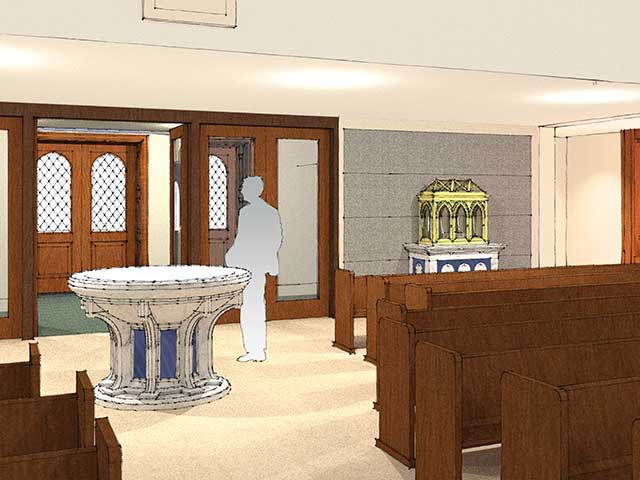
Baptismal Fount
Sandy Dominick, a member of the Diocesan Pastoral Council, said, “When we come to our cathedral from across our diocese of 70 parishes, we gather to make new friends, to share in the liturgies, to grow in holiness, to walk closely with God and to fulfill our baptismal promises through the gifts and love Jesus gives us in the sacraments shared with one another. Then we are sent forth to share his love in our own environments.”
Image: Near the entrance, the faithful will find a baptismal fount, serving as a reminder of their own baptism and formal entrance into the Church.
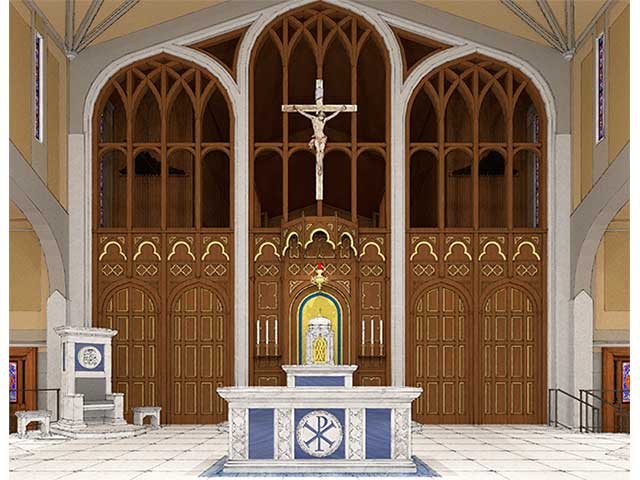
Sanctuary
Inside the cathedral, the most significant change will be the design of the sanctuary. Previously, the bishop’s chair was in the center and the tabernacle to the side. The new design will place the tabernacle — in which our Eucharistic Lord resides — in the center. This simple but significant change returns to the original layout of the church prior to its elevation as a cathedral.
More importantly, it gives a physical, architectural expression to the centrality of the Eucharist in our lives. “It is in Christ, and his gift of the Eucharist, which we find true happiness,” said Father Patrick L. Posey, cathedral rector. “Placing the tabernacle where his sacrificial love for us is offered reinforces this centrality of our relationship with him. The tabernacle can be seen, then, as an invitation to worship and converse with Jesus; moreover, it is an invitation to witness — to become, as our patron saint reminds us, ‘God’s servant(s) first.’ ”
Image: The new sanctuary design will place the tabernacle in the center.
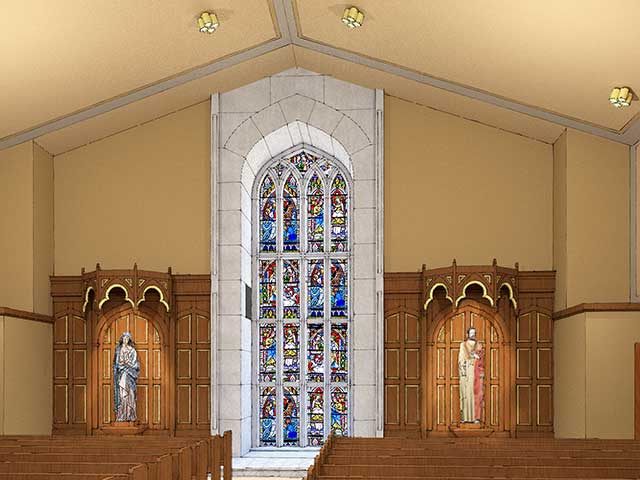
Mary and St. Joseph
A cathedral is a beacon of hope. With timeless architecture and art, it is a reminder that while times change, God’s promises never change nor do the truths he has taught us. People can look at the church and know that we stand upon the bedrock of faith and rely upon God’s eternal word.
Image: Ornamenting the east transept, dedicated to Mary and St. Joseph, are images in stained glass depicting the life of the Holy Family. Statues of Mary and St. Joseph flank these new windows, fostering devotion to the Mother of God and foster father of Jesus.
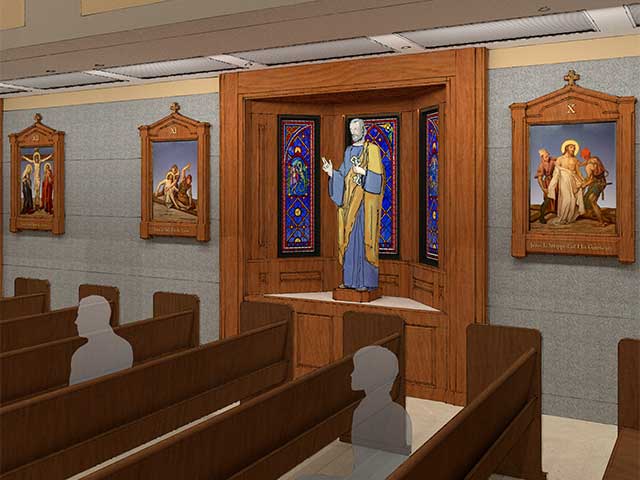
Multicultural devotional shrines
The new cathedral design will have devotional shrines with statues of various saints. Because the cathedral represents all the faithful of the diocese, these shrines will represent the different cultures and communities located throughout the diocese. Behind each statue will be stained-glass windows that tell the story of that saint’s life. The cathedral will exemplify both the oneness and the diversity of the diocese — that our one body has indeed many parts.
“Representatives from the various cultural groups in the diocese are thrilled to have this opportunity to leave a lasting thumbprint on our Mother Church,” said Bridget Wilson, diocesan director of multicultural ministries. “The saints they have chosen are amazing witnesses to the faith and will be a constant reminder to all who visit that, though many, we are one body in Christ.”
Image: Devotional shrines will be located throughout the cathedral.
Expand / Collapse All
Will there be memorial opportunities?
Yes. Opportunities will be made for individuals or families to memorialize a loved one, couple or family. For any interested in doing so, please contact Robert Mueller, director of development, at [email protected].